
OPERATIONS DEVELOPMENT SUPPORT FOR OPTICAL AND QUANTUM GROUND INFRASTRUCTURE
SL-6C.031-P2
ESA Contract No. 4000140013/22/UK/AL
The “Operations Development Support for Optical and Quantum Ground Infrastructure” is an ESA initiative focused on developing and supporting the infrastructure of an optical ground station in the island of Crete (Greece), which is crucial for modern space communication technologies. The main objective is to provide support for the transformation of the Skinakas observatory into an Optical Ground Station (OGS) for optical communication. This activity provides operational support to ESA Contract No. 4000140646/23/NL/AF (Activity Reference 6C.012/SL.048) SKINAKAS OBSERVATORY UPGRADE FOR OPTICAL AND QUANTUM COMMUNICATION (22SkinUp).
| SKINAKAS OBSERVATORY |  |
Skinakas Observatory is a joint research facility of the University of Crete and the Foundation for Research and Technology – Hellas (FORTH). Its prime objective is to conduct fundamental research in Astrophysics as well as to promote astronomy and enjoying the wonders of the night sky to the general public in Greece. Skinakas Observatory is dedicated to research projects addressing cutting-edge topics in astrophysics. Data obtained with this telescope have contributed to ~300 peer-reviewed publications, which have collectively received ~9000 citations. The importance of this site for astrophysical research is internationally recognized.
The 1.3m Skinakas telescope has been selected to support the ESA ScyLight programme, as well as the HydRON and SAGA projects, which prepare the space segment of the European Commission’s EuroQCI Initiative. The observatory will also contribute to the recently approved SEEWQCI (South-East Europe to Western Europe Quantum Communication Infrastructure) and TransEuroOGS projects.
To this end, ESA launched two Invitations to Tender (ITTs) under the ARTES 4.0 strategic programme line Optical Communication – ScyLight. One ITT focused on the design, construction, and implementation of the optical communication system, while the other provided operational development support. These activities were awarded to two institutes of the Foundation for Research and Technology–Hellas (FORTH): the Institute of Electronic Structure and Lasers (IESL) and the Institute of Astrophysics (IA), respectively. These two projects are:
22SkinOPERATIONS (Coordinated by IA): Operational development support, including integration and operation of the optical communication system with the 1.3 m telescope.
22SkinUP (Coordinated by IESL): Design, construction, and implementation of the optical communication system.
OBJECTIVE
The main objective of the activity is to provide initial operational development support to optical ground stations (OGS) developed within the European Quantum Communication Infrastructure (EuroQCI) and the ESA nucleus ground station networks and those OGS selected for testing technologies developed within ARTES ScyLight activities. More specifically and applied to the Greek initiative, the project aims to convert Skinakas into an OGS capable to track LEO space objects and detect optical signals.
To achieve this goal the Skinakas team must carry out several activities that have been grouped into three Work Packages:
- WP1. OGS equipment reception and inventory update: This involves creating a detailed inventory of existing and missing equipment, procuring necessary items, and inspecting and testing all OGS subsystems. An online logbook has been set up to track equipment, operations, and issues. The inventory list can be found here.
- WP2. Equipment Installation and Familiarization: Using the equipment received the team worked on installing and aligning equipment on the telescope, implementing software and computer interfaces, and conducting system operational status testing. Through these activities the staff will be trained and familiarized with observations running.
- WP3. Satellite operation campaigns: Having conducted the previous steps, the consortium will demonstrate system operation by conducting tests and dry runs that will showcase the operational level achieved.
PROJECT MAIN UPGRADES AND ACHIEVEMENTS
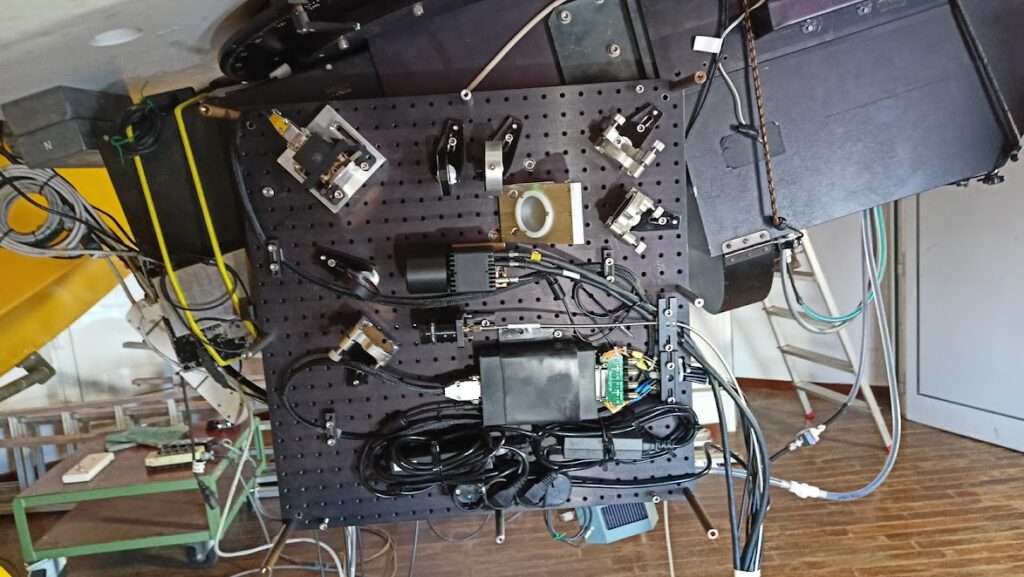
- Optical system. Pointing, Acquisition, Tracking (PAT) module: It was designed and developed by the Institute of Electronic Structure and Laser (IESL-FORTH) within the framework of the ESA activity 6C.012/SL.048. The SkinUp web site gives more details on the activity. The main components are shown below, while the operation manual can be found here.
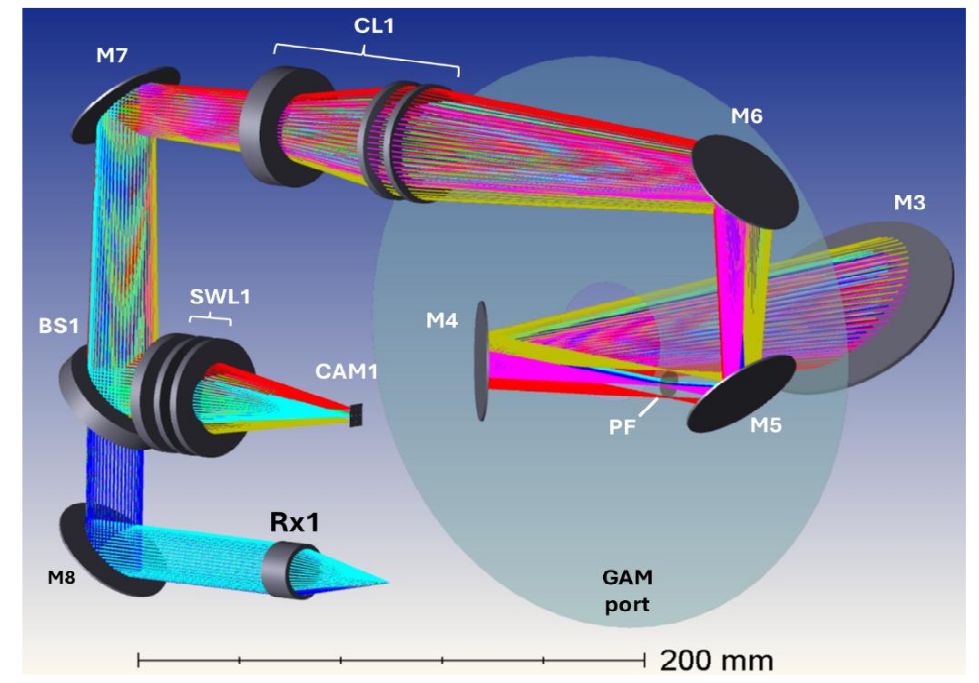
M3: GAM distribution mirror.
M4: Re-directional mirror.
PF: Primary focus plane.
M5: Re-directional mirror.
M6: Re-directional mirror.
CL1: Collimator module.
M7: Tip-tilt mirror.
BS1: Beam splitter.
SWL1: SWIR camera lens module.
CAM1: SWIR (C-RED 3 ANDOR) camera.
M8: Adaptive Optics port mirror.
Rx1: Fiber coupler module.
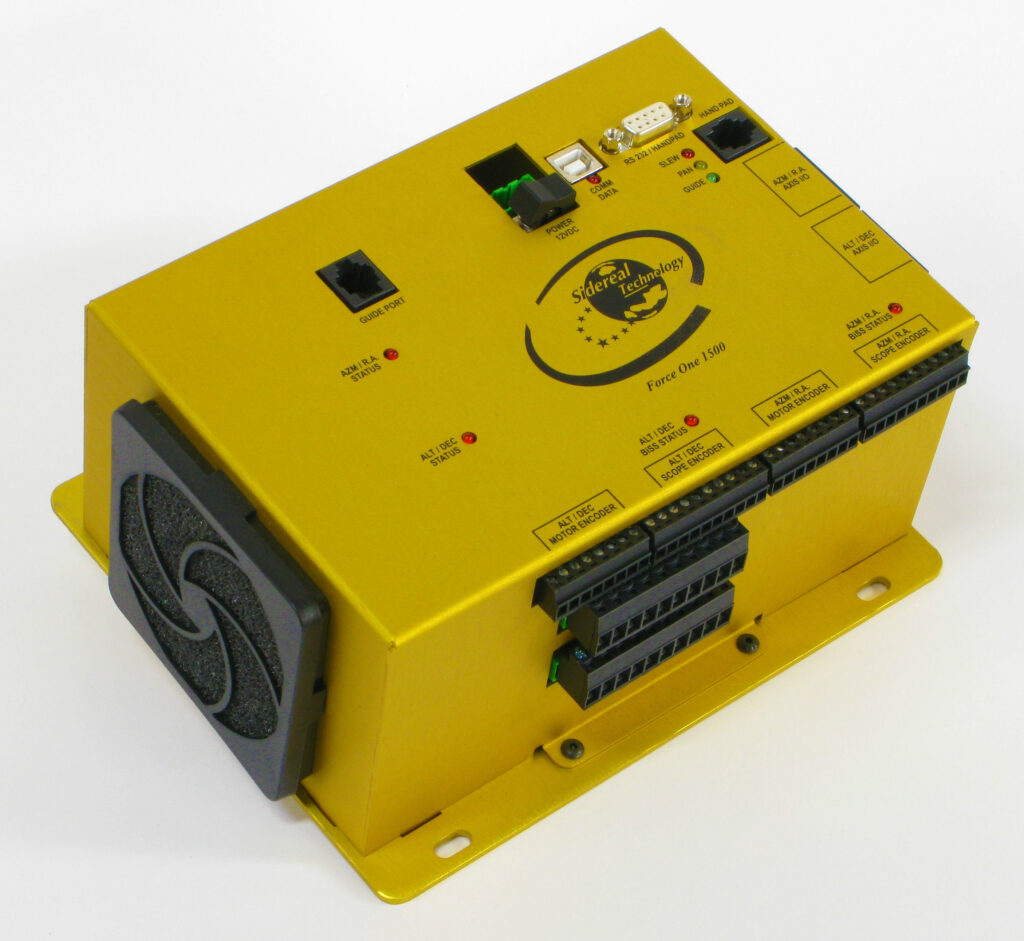
- New Telescope Control System: In order to be able to use the 1.3m telescope to track LEO satellites, the controller of the Telescope Control System was replaced. A Force One controller from SITECH manufacturer replaced the old TCS. The new controller allows extremely high speed encoder inputs and more memory for future enhancements. It has USB and RS232 connections and a built-in auto-guider among other features. The new system also includes a more precise telescope position encoder, a customized dome controller which replaces the old TCS, a new focuser and specific telescope mirror flaps controller.
- Demo video of the tracking of a LEO satellite with the new telescope controller.
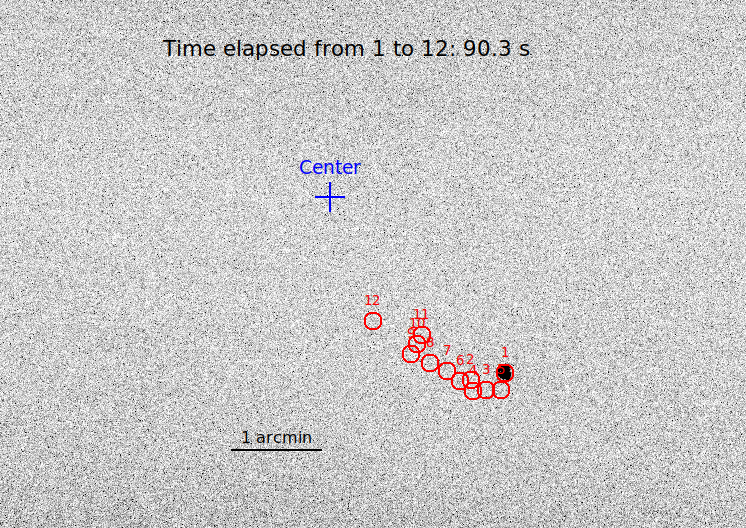
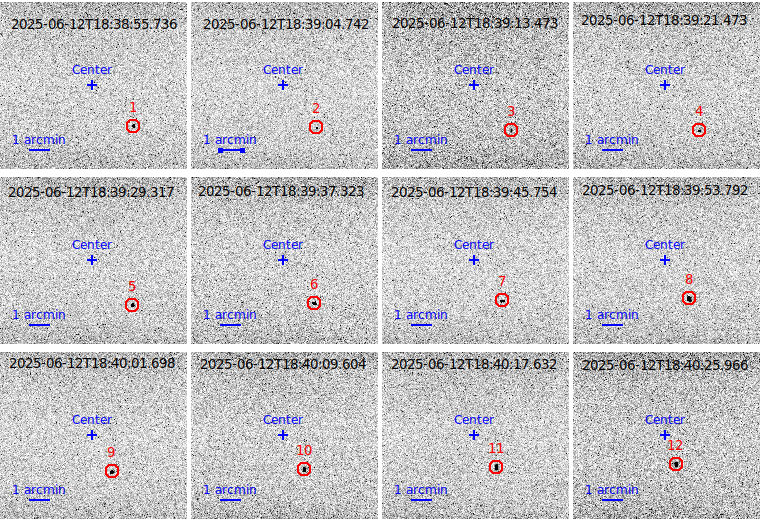
- OGS preliminary operations. The implementation of the OGS requirements requires careful planning to ensure that both activities—astronomy and optical communication—can be carried out effectively without interfering with each other. While the installation and integration of the optical communication system can be performed during daylight hours, the execution of the test campaigns must take place at night, when satellites are visible due to reflected sunlight. The main objective of this action was to evaluate the upgraded 1.3 m telescope controller’s ability to point to and track LEO satellites prior to the final installation of the PAT breadboard. This included conducting a dry run of a satellite pass to identify potential issues—such as reaching telescope motion limits or unexpected dome behavior—prior to the actual satellite tracking tests
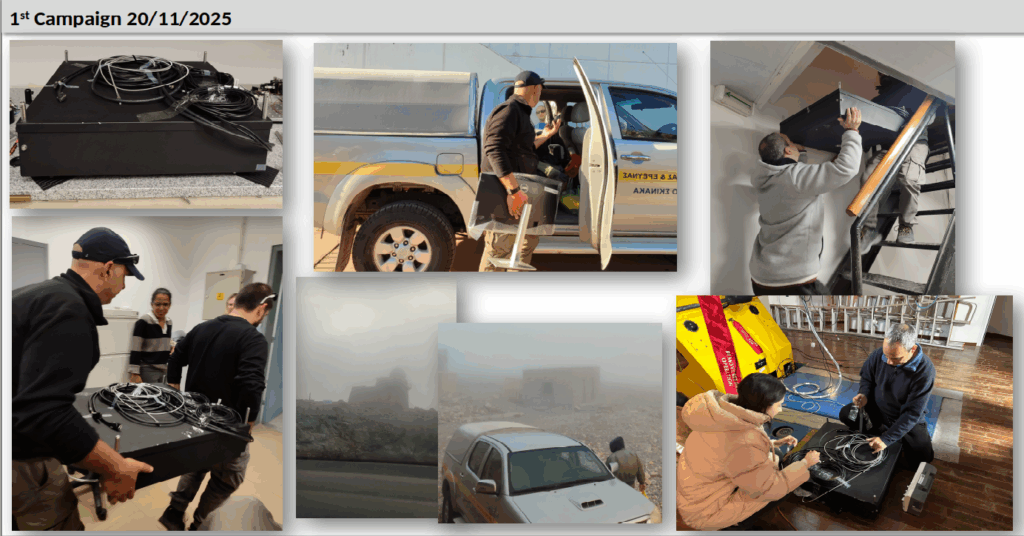
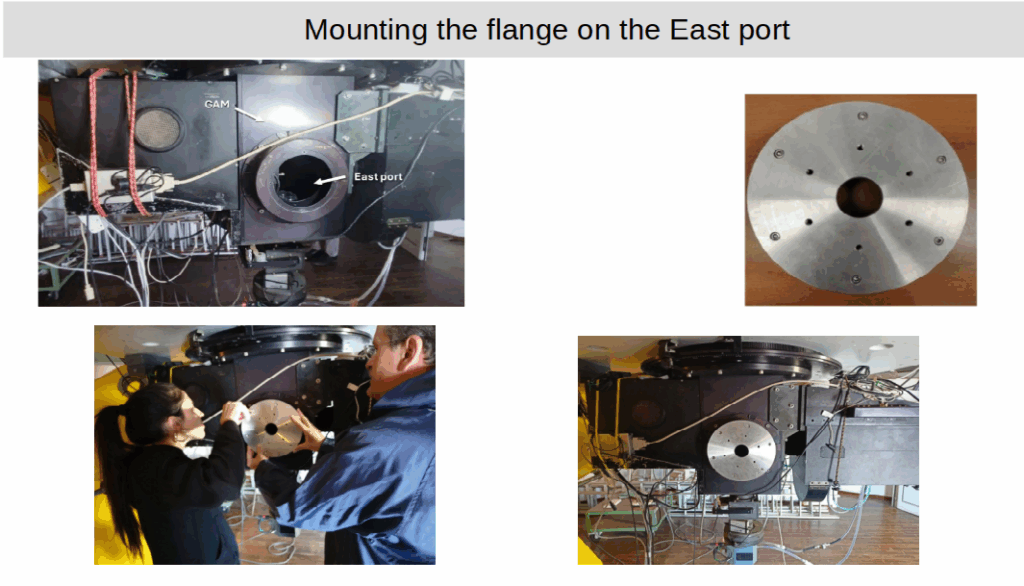
- Integration and Installation. The optical communication system, designed and assembled by IESL-FORTH, was installed on the East GAM port of the 1.3 m telescope. To adapt the PAT breadboard to the telescope’s GAM interface, a custom adapter flange was designed. This flange serves as a mechanical interface between the GAM flange and the entrance port of the breadboard. It is first mounted onto the GAM flange, after which the PAT breadboard is attached using a set of precisely positioned threaded holes on the flange side and matching holes on the breadboard side. The installation on the 1.3 m telescope GAM was performed by the IA technical personnel, with upervision from a junior member of the IESL-FORTH team. This confirmed in practice that the optomechanical design is robust and installation can be seamlessly performed by the technical personnel of the Observatory without the need of specialized experts.
- OGS final operations. On 20th and 21st November 2025, the PAT saw “first light”. After telescope balance and motion limit check,the telescope pointed at several bright stars to test the fast steering mirror (FSM) and the ability to perform close loop operations. During the campaigns, we managed to track various stars and force the FSM mirror closed loop to grab and keep on center the star from various points in the SWIR FOV, and also correct on forced alt-azimuth shifts introduced by the telescope controller. The results were excellent. The system quickly corrected on forced alt-azimuth shifts introduced by the telescope controller.
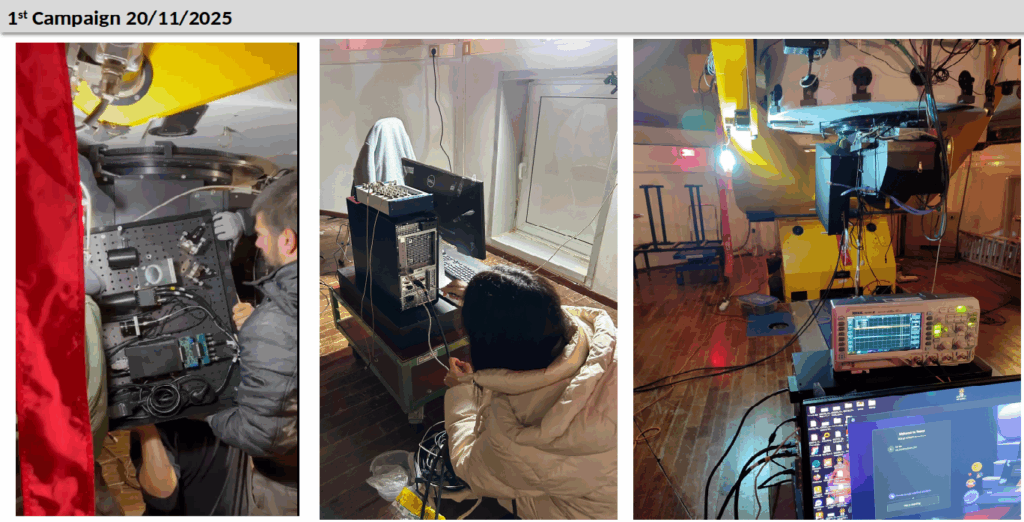
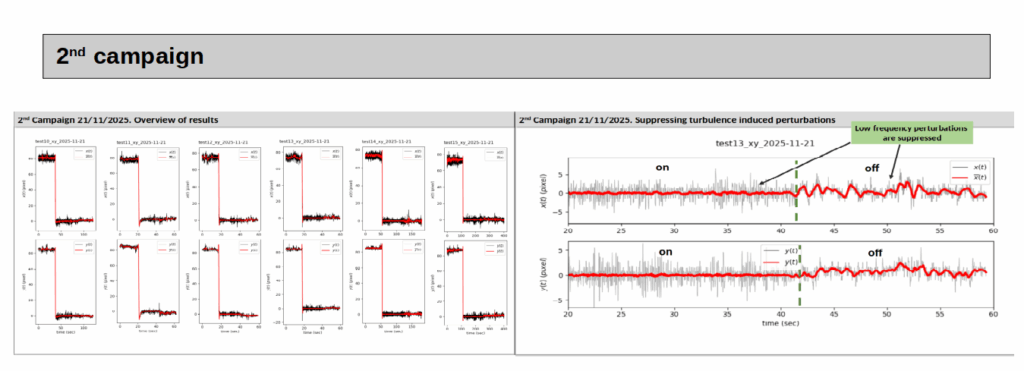
The close-loop system worked efficiently. However, as a result of the misalignment between the center of the PAT’s FOV and the center of the telescope’s FOV, a manual correction, using the wide field guide scope of 1.3 m telescope, was applied to bring objects of interest (i.e. stars) within the FOV of the SWIR camera. This process takes a couple of minutes and prevented the use of auto-tracking for LEO satellites. The problem can be easily solved in the laboratory and will be implemented in the next observational campaign.
FUTURE DEVELOPMENTS
The optical communication system developed by IESL-FORTH was designed for installation on the 1.3m telescope at the Skinakas Observatory. At the time of the call, this was the only telescope available for the activity. The telescope was upgraded with a new controller capable of processing extremely high-speed encoder inputs and offering expanded memory for future enhancements. The new system also incorporates a more precise position encoder, a customized dome controller to replace the old Telescope Control System (TCS), a new focuser, and a dedicated controller for the telescope mirror flaps.
A significant constraint that could not be resolved is the slow rotation speed of the observatory’s 8m dome, which hosts the telescope. The dome rotates at only 1.7°/s, taking 210 seconds to complete a full revolution. With a slit design, only a limited portion of the dome is open during operations. These factors make tracking Low Earth Orbit (LEO) satellites with the 1.3m telescope challenging. While we demonstrated that tracking certain LEO satellites is not impossible, the system cannot track any arbitrary LEO satellite due to these mechanical limitations.
Despite these difficulties, IESL-FORTH designed a compact and modular optical system that can be adapted to other telescopes with minimal effort.
We propose deploying the system on other telescopes at Skinakas. In particular, on the AZ1200 that will be available from June 2026. This telescope will be hosted in a 5.3m dome expected to rotate at about 6°/s, sufficient for LEO satellite tracking.